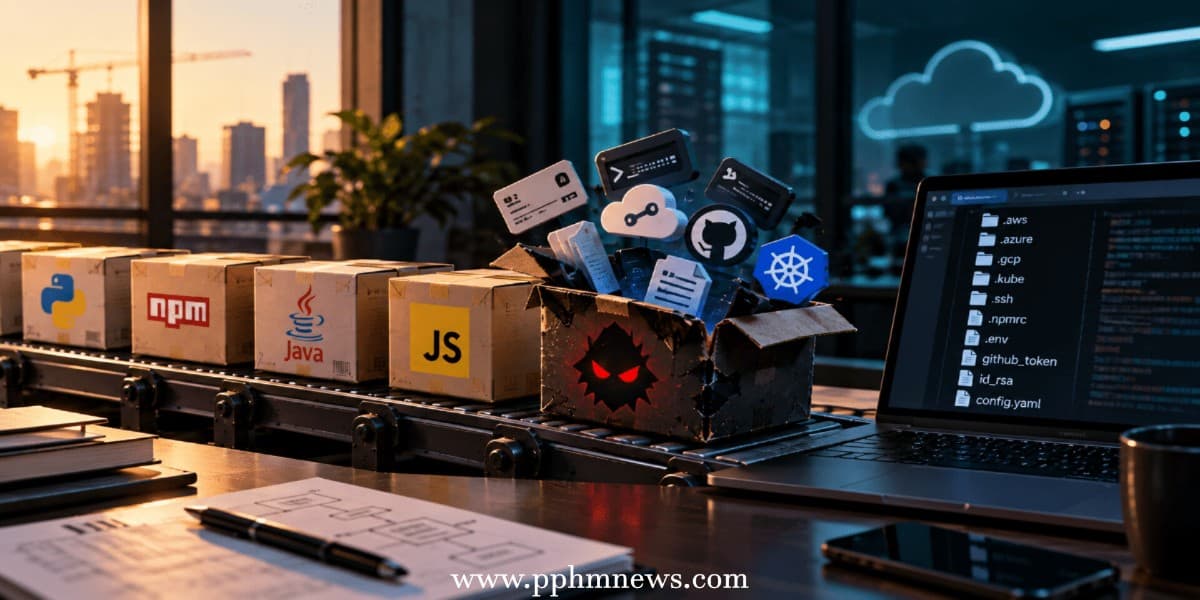
Package Compromise Opens a Direct Path Into Enterprise Infrastructure
Software supply-chain attacks are expanding beyond source-code manipulation as threat actors increasingly use trusted dependencies to steal credentials from developer workstations and CI/CD environments.
The technique turns a routine package installation into an identity compromise. Once malicious code executes, attackers can search the development environment for cloud credentials, repository tokens, deployment secrets and authentication material—potentially gaining access to production systems before the affected application is even launched.
Installation Hooks Execute Before Applications Run
A key weakness lies in package-manager lifecycle functionality.
Malicious Scripts Activate During Dependency Installation
In the Mini Shai-Hulud campaign cited in the report, compromised @antvnpm packages used apreinstallhook to execute an obfuscated payload duringnpm install.
This means abandoning the installation afterward may already be too late: credential collection can begin while the dependency is being installed.
Developer Machines Hold High-Value Secrets
Modern development environments often maintain authentication material for multiple infrastructure platforms.
One Endpoint Can Unlock Several Services
Attackers can search predictable locations for assets including AWS credentials, Azure sessions, GCP service accounts, GitHub tokens, npm publishing credentials, Kubernetes configurations, SSH keys and HashiCorp Vault tokens.
Recent supply-chain campaigns have specifically targeted GitHub Actions, AWS, Kubernetes, npm, Vault and other developer environments.
A single compromised workstation or build runner can therefore provide access far beyond the original package ecosystem.
Stolen Tokens Can Extend the Compromise
Credential theft creates the possibility of a cascading attack.
Package Access Can Become Cloud Access
A stolen npm publishing token may allow attackers to modify additional packages. Compromised GitHub credentials can expose repositories or CI/CD workflows, while cloud credentials can provide access to storage, virtual machines, serverless infrastructure, secrets and Kubernetes workloads.
This creates a dangerous feedback loop: one poisoned dependency steals credentials that can potentially be used to compromise additional trusted dependencies or infrastructure.
Supply-Chain Defense Must Include Identity Monitoring
Traditional software-supply-chain security focuses heavily on detecting malicious packages and verifying code integrity.
That is no longer sufficient.
Security teams should also monitor developer identities, package-manager lifecycle execution, unusual token use, cloud authentication from unexpected locations and access to sensitive credential files during dependency installation.
The broader lesson is that the modern software supply chain is becoming an identity attack surface. Protecting source code matters, but organizations must increasingly assume that the credentials surrounding development pipelines are equally valuable targets.