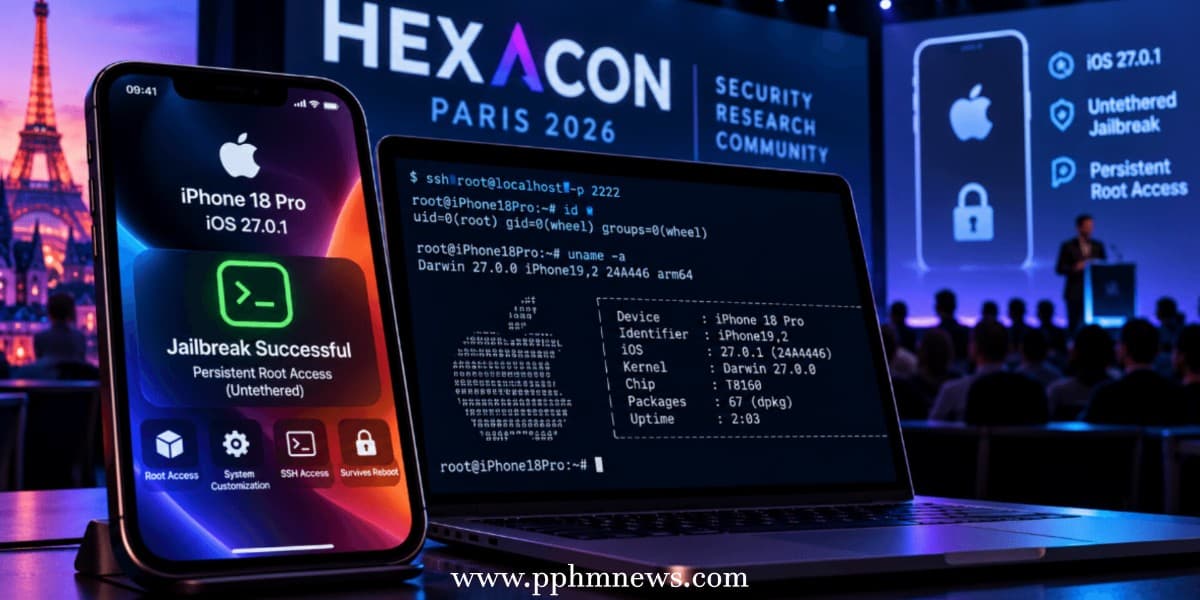
Paris Conference Reveals Reboot-Resistant Privilege Escalation on Flagship Handset
Security research firm Calif has demonstrated an untethered jailbreak on Apple's iPhone 18 Pro running iOS 27.0.1, marking a significant development in modern mobile exploitation.
The demonstration took place on October 16, 2026, at the Hexacon security conference in Paris, where researchers showed that privileged system access remained available after the device restarted.
Unlike conventional jailbreaks that require a computer or repeated exploitation following a reboot, the demonstrated technique restored its modified operating environment without external assistance.
However, Calif has not published the underlying vulnerabilities, exploit code, or a publicly usable jailbreak tool.
Live Demonstration Confirms Persistent System Access
During the presentation, researchers restarted an iPhone 18 Pro and allowed it to complete its normal startup sequence.
Remote Shell Verifies Administrator Privileges
After unlocking the device using its passcode, the team established an SSH connection through port 2222.
The terminal returneduid=0, confirming that the session operated with root privileges.
Technical information visible during the demonstration included:
- Device: iPhone 18 Pro, identifieriPhone19,2
- Operating system: iOS 27.0.1, build24A446
- Kernel: Darwin 27.0.0
- Chip identifier: T8160
- Installed packages: 67 throughdpkg
The device reported approximately two minutes of uptime, indicating that privileged access was available shortly after restarting. This does not establish the exact time required to execute the jailbreak.
Persistent Exploitation Challenges Apple's Security Architecture
Modern iPhones employ multiple protections designed to prevent unauthorized applications from accessing privileged operating system components.
Multiple Security Boundaries May Be Involved
These protections include application sandboxing, mandatory code signing, kernel isolation, and hardware-assisted Pointer Authentication Codes (PAC).
Achieving root access on a current iPhone generally requires overcoming several security boundaries. Maintaining that access across reboots introduces additional complexity.
The Calif demonstration establishes that a persistent privileged environment was achieved, but it does not reveal which defenses were bypassed or how persistence was implemented.
Artificial Intelligence Reportedly Assisted Research
Reports surrounding the presentation indicate that AI-assisted techniques contributed to the vulnerability research.
Exploit Development Details Remain Undisclosed
Calif has previously explored AI-supported vulnerability discovery, but the company has not released a technical breakdown identifying the models, tools, or methods responsible for this particular exploit chain.
Claims about the precise role of artificial intelligence should therefore remain provisional until additional evidence becomes available.
Public Exploitation Risk Remains Uncertain
The research challenges assumptions about the difficulty of compromising Apple's newest mobile hardware.
No Public Release or Confirmed CVEs
As of October 17, 2026, no public jailbreak package or verified CVE identifiers have been associated with the demonstration.
The presentation also did not establish whether the technique could compromise a locked device without its passcode, whether remote exploitation is possible, or which additional iPhone models are affected.
There is no confirmed evidence linking the demonstrated method to active attacks against users.
Security Implications Extend Beyond Device Customization
Persistent root access is relevant not only to jailbreak enthusiasts but also to mobile spyware research and enterprise device protection.